FEDHASA Inland Board Member & CEO of Stonehaven on Vaal
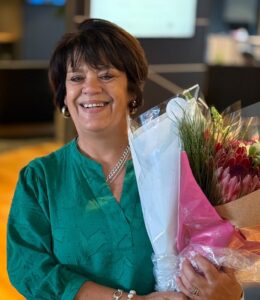
Rosemary Anderson has spent decades creating guest experiences that matter and building people up in the process. As CEO of Stonehaven on Vaal, a FEDHASA Inland Board Member, and former FEDHASA National Chairperson, Rosemary brings both the long view and the ground-level perspective to some of the industry’s most important conversations. This Women’s Month, she speaks candidly about the career that chose her, the leaders she’s helped shape along the way, and why economic independence for women isn’t just a workplace issue, but one of the most powerful tools we have for building stronger families and communities.
1. What first drew you to hospitality and tourism, and what’s kept you in it all these years?
I didn’t deliberately choose a career in hospitality – in many ways, hospitality chose me. Looking back, I realise it suits my personality, because I genuinely enjoy creating experiences that people remember.
Whether it’s a birthday, wedding, anniversary, or simply providing a place where friends and family can relax together, I enjoy taking care of the finer details that make an occasion more enjoyable. Hospitality is ultimately about making people feel welcome and valued, and hopefully exceeding their expectations.
The greatest satisfaction, however, comes from watching colleagues develop. Seeing someone start as a housekeeper or waiter and progress into management, buy their first car or home, or put their children through university is far more rewarding than any business achievement. Creating opportunities for others has been the most satisfying part of my career.
2. Women are still underrepresented in senior roles across the industry. What do you think businesses should be doing to change that?
Businesses need to move beyond discussing diversity and demonstrate it through their appointments, promotions, and leadership opportunities. Actions always speak louder than policies.
Hospitality is fundamentally a people business. It requires empathy, communication, organisation, the ability to anticipate guests’ needs, and multitasking skills. These are qualities that many women bring naturally to leadership roles.
For women entering the industry, my advice is not to become distracted by outdated attitudes or stereotypes. Instead, focus on becoming exceptionally good at what you do. Deliver results consistently and professionally, and your work will speak for itself. If someone underestimates you because you’re a woman, treat it as motivation rather than an obstacle, and if you can respond with good humour along the way, even better.
3. Looking back on your career, what’s the achievement you’re proudest of, not just for the result, but for the difference it made?
Without hesitation, creating employment opportunities.
Our industry measures success in occupancy levels, covers served, average spend, and guest satisfaction scores. Those metrics matter, but they’re not what I value most.
What gives me the greatest sense of achievement is knowing that my business has provided employment for hundreds of people over the years and, in doing so, helped them improve their quality of life, support their families, and create educational opportunities for their children that they, themselves, never had.
Businesses succeed because of their people. Seeing those people succeed in their own lives is, for me, the greatest achievement.
4. What advice would you give a young woman just starting out who wants to end up in a leadership role one day?
The best advice I ever received came from my father:
“If you want to get anywhere in life, you have to work harder than everyone else.”
That advice has stayed with me throughout my career.
I would also encourage young women to become known as people who find solutions rather than problems. Always ask yourself how you can assist, not why something can’t be done. Learn to anticipate what colleagues or guests need before they ask – that is one of the foundations of excellent hospitality.
Be reliable, be kind, continue learning, and don’t allow difficult narcissistic personalities to undermine your confidence. Your professionalism and consistency will always outlast someone else’s ego.
5. What makes you feel positive about the next generation of women coming into tourism and hospitality?
What gives me the greatest optimism is that the next generation of women is entering our industry with greater confidence and higher expectations of themselves than ever before. They’re less willing to accept outdated workplace attitudes, more prepared to contribute ideas and challenge convention, and they have a real appetite for continuous learning. That can only strengthen our industry.
Hospitality is also one of South Africa’s largest employers of women. Every new skill learned and every career opportunity has the potential to change not only one person’s future, but that of an entire family.
That is why I believe our industry has an important role to play in addressing one of South Africa’s greatest challenges: gender-based violence (GBV). While GBV is a complex issue with many contributing factors, economic dependence often makes it far more difficult for women to leave abusive relationships. Employment, career development, and financial security help remove one of those barriers by giving women greater independence and choice.
If I could wish for one thing this Women’s Day, it would be for every woman to have the opportunity to become financially independent. Economic independence gives women the freedom to create opportunities for themselves and build the future they choose. Most importantly, no woman should ever feel compelled to remain in an abusive relationship because she lacks the financial means to leave. Every woman deserves the confidence, dignity, and security that comes from being able to stand on her own two feet.
As an industry, if we continue creating opportunities for women to grow, lead, and succeed, we will not only build stronger hospitality businesses – we will help build stronger families and communities.
Viva Women in Hospitality!